Thursday, August 31, 2006

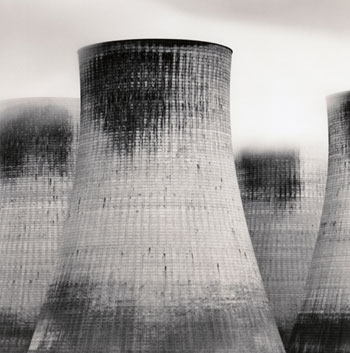
Ratcliffe Power Station

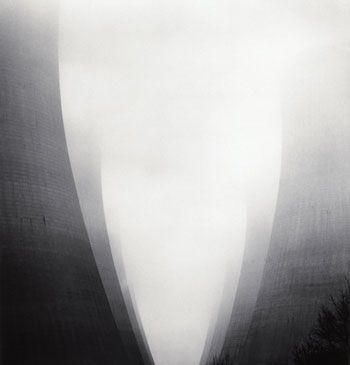
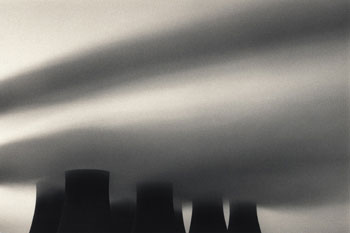
[Images: The archetypically geo-monolithic cooling towers of Ratcliffe Power Station, Nottinghamshire, England, photographed by Michael Kenna (©). Don't miss Kenna's recent work, including these spectacular photographs of Hokkaido – then go buy his 20-year retrospective. Earlier: Nuclear ambition].

Wednesday, August 30, 2006

Beijing Orbital

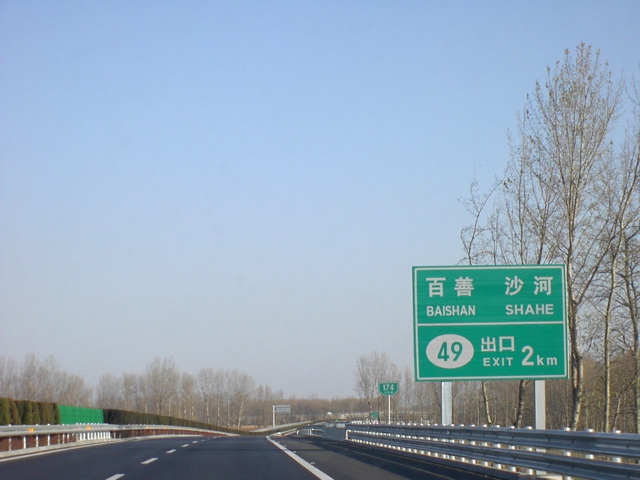
[Image: "The northernmost, barren reaches" of Beijing's 6th Ring Road. From Wikipedia].

In a recent interview with Ballardian.com, British author Iain Sinclair mentions that he hopes to begin a project called Beijing Orbital:
    When I was in Stavangar in Norway at one of these strange conferences, I saw a presentation by an assistant of Rem Koolhaas which was about the China TV building he’d built. He showed this virtual version of a city with seven orbital motorways just spreading out from the centre of this very traditional city into the desert, and the incredible pieces that were going up. I thought my god, it will be amazing to travel around these seven orbital motorways. Of course, that is relatively attractive to be made into a film. I think it will be reasonably possible to get a commission for that, which may also become a book. It will also involve me doing a lot of other things – circling round China as to what China means to different places in Europe, in the sense of Fu Manchu or people being drowned in Morecombe, all these stories, before I even embark on a journey to the place itself.
Maybe BLDGBLOG will beat him to it. Interested funders be in touch.

Nuclear Ambition

New Scientist reports that the cooling towers of nuclear power plants "could be evolutionary hotspots for new respiratory diseases."
It's architecture as a stimulus for Darwinian novelty.

[Image: Didcot power station; from Wikipedia].

The "warm, wet conditions" inside the towers have been found to host "several previously unknown strains of bacteria, including some that were similar to Legionella pneumophila, the cause of legionnaires' disease." The scientist behind this discovery warns that cooling towers are thus a source of pathogenic "aerosols" – invisible germ-clouds blowing out from their architectural origins to infect the lungs of animals nearby.
This nuclear landscape of concrete hyperboloids belching steam, and virulent microbes, into the sky should therefore "be monitored for emerging pathogens." Super-germs. Radioactive pneumonia.
Sci-fi novelists, heads up: a new plot beckons.

The U.S. Army Permafrost Tunnel

Between 1963 and 1965, the U.S Army Permafrost Tunnel was dug "entirely within frozen ground on the north slope of Hill 456 near Fox, Alaska."

Ice_Intrusion_155_ft_deep"Initial research" at the site "focused on developing new mining and tunneling methods for building underground facilities and foundations in permafrost. Special emphasis was given to tunnel behavior in permafrost, including deformation, natural air flow, feasible types of ventilation and thermal regime."

The tunnel is now maintained by the U.S. Army Corps of Engineers' Cold Regions Research and Engineering Laboratory – whose work "includes an amazing array of topic areas, including engineering and technology in cold regions, seismic-acoustic physics, tools for military combat and survival in cold weather, and many others."

If you're hoping to explore the place in person, however, beware that the tunnel's structure "requires a freezer unit" in order to survive the Alaskan summer – lest the whole place spontaneously liquify...
Meanwhile, soon to be discovered: a whole city of post-military ice caves, carved throughout the Alaskan peninsula and populated entirely by sightless humanoids – who are victims of an Army gene experiment gone awry.
Starring Samuel L. Jackson as a hot-headed spelunker who discovers his own father living nude in the deepest tunnel. "Enough is enough!" Jackson yells. "I have had it with my motherfuckin' father living in this motherfuckin' cave!"

Monday, August 28, 2006

Dwelling in an age of aeromodernism

lrg_roof_airportIn an old (1938) issue of Modern Mechanix, we read how an unnamed "French engineer" once proposed, "as a solution to the problem of locating an airport in the heart of any big city, a design for a long orientable runway, which would be mounted on circular tracks atop tall buildings." This megalithic, concrete, aerospatial earth machine would "orient" itself along specific air routes, hurling planes aloft over the rooftops of the city.

Though Modern Mechanix tags the idea with both "aviation" and "impractical," clearly the editors have not read this fascinatingly absurd, and much less practical, conspiracy theory about Denver International Airport.

"What on earth is going on at Denver International Airport?" the website asks. "Or should we be asking what is going on UNDERGROUND there?" According to the conspiracist's own "guerrilla" reportage:
    • The Queen of England has reportedly been buying up property in Colorado under a proxy.
    • There is a lot of "secret society" symbology at the airport, an AWFUL lot in fact
    • The symbolism apparent in the layout of the new Denver airport, some feel, says that it may be a control center for world control
And so on. Apparently some of the airport's murals are a bit dodgy – and that can only mean one thing... An AWFUL lot of one thing, in fact.

In any case, another (much more fascinating) article about urban airports of the future came out last month in Fast Company. There we read about the "rise of the aerotropolis":
    In the relatively obscure world of urban planning, [John] Kasarda, a professor at the University of North Carolina's Kenan-Flagler Business School, has made a name for himself over the past decade with his radical (some might say bone-chilling) vision of the future: Rather than banish airports to the edges of cities and then do our best to avoid them, he argues, we should move them to the center and build our cities around them.
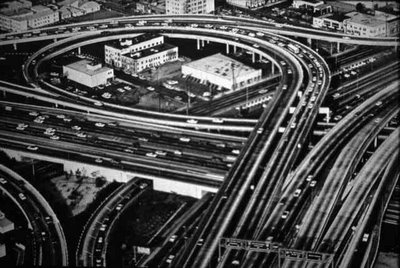
ISS013-E-19323_lrg[Image: The neolithic geometry of Dallas-Fort Worth International Airport, a future archaeological complex which "occupies more surface area than the entire island of Manhattan." Image courtesy of NASA's Earth Observatory].

Kasarda points out that an "invisible plexus of air-cargo networks" allows globalization to function. This is space as re-defined by corporate proximity, international accessibility, and cargo transport logistics:
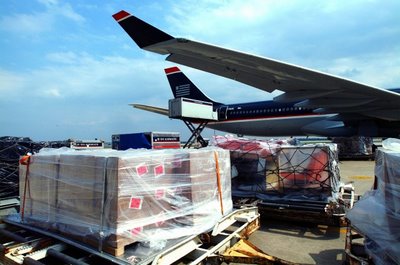
    Over the past 30 years, Kasarda will tell you, global GDP has risen 154%, and the value of world trade has grown 355%. But the value of air cargo has climbed an astonishing 1,395%. Today, 40% of the total economic value of all goods produced in the world, barely comprising 1% of the total weight, is shipped by air (and that goes for more than 50% of total U.S. exports, which are valued at $554 billion). Raw materials and bulkier stuff still take the slow boats, but virtually everything we associate with our postindustrial, value-added economy – microelectronics, pharmaceuticals, medical devices, Louis Vuitton handbags, sushi-grade tuna – travels via jumbo jet. We may think of the 1960s as the jet-set era, but the supremacy of (soft) airpower has only now begun to reshape our ideas about how cities should look, how they should function.
On the other hand, no mention of climate change – let alone air pollution, or the rising cost of jet fuel – is to be found.

Instead, we read, Hong Kong is now "premising its entire world-trade strategy on the primacy of the airport." Indeed, there is already "a mini-city stationed on a nearby island for [the airport's] 45,000 workers" – not to mention SkyCity, "a complex of office towers, convention centers, and hotels" for visiting CEOs and their consultant-class co-travelers.

In Beijing, "construction has begun on Beijing Capital Airport City, a $12 billion master-planned city of 400,000, and a massive airport expansion is coming to the city of Guangzhou, in the Pearl River Delta. Thirty-three miles to the south of Seoul, New Songdo City, billed as the most ambitious privately financed project in history, is taking shape in the Yellow Sea: The metropolis of 350,000 people, many of them expatriates living and working on-site for multinationals, is being built on a man-made peninsula the size of Boston."
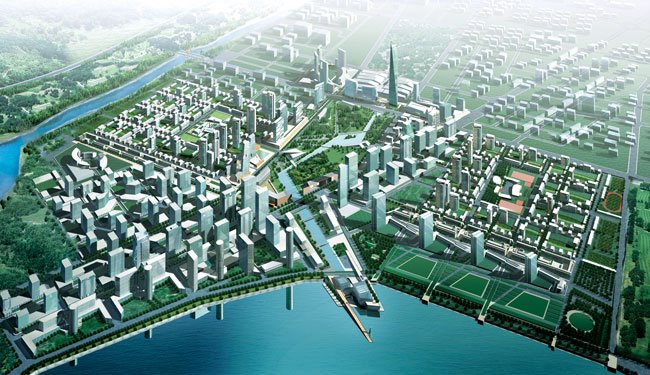
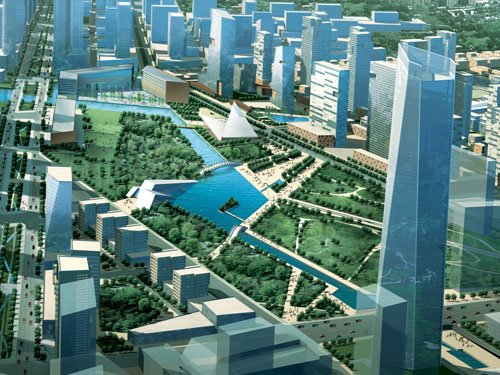
[Images: New Songdo City; courtesy Kohn Pederson Fox. New Songdo City was covered a long time ago on BLDGBLOG at the very end of this post].

Dubai, Frankfurt, Amsterdam, Suvarnabhumi – the latter an airport-city in Thailand "slated to become a self-contained province governed by the prime minister himself" – everywhere, we're led to believe, will soon turn in to an aerotropolis. It is the next phase of urban anthropological history.

This new land use model, after all, is where we will find the "hotels, merchandise marts, [and] convention centers," the "free-trade zones, factories, warehouses, and logistics hubs," the "giant clusters of apartment towers and bungalows," within which expat middle managers and their armies of business process consultants will both work and dwell. It is a heroic landscape through which the aero-globalized networks of world trade now pass – a new, post-urban "ecosystem" consisting entirey of "warehouses, trucking firms, factories, and offices," all "laboring in the shadow of the airport."

And if my phrase heroic landscape sounds hyperbolic, Fast Company refers to these aerotropoli as nothing less than "the regional outposts of titans."

Finally, the article returns to Kasarda:
    Despite a fondness for Olympian pronouncements, Kasarda is neither a Le Corbusier nor a Robert Moses (to name just two men who wanted to mold cityscapes in their own images). He sheepishly concedes that his visions of monstrous highways and multimodal cargo hubs would make Jane Jacobs – the late patron saint of human-scale cities – toss and turn in her grave.
So it's an article worth reading – though I would first point out that the ideas, of course, aren't new. At the very least, J.G. Ballard predicted all of this forty years ago; and then there's Iain Sinclair, who recently wrote that "Heathrow is its own city, a Vatican of the western suburbs."
What future Odyssey might be written in this archipelago of aerotropoli? From airport to airport, flying round the world, never seeming to leave one place... thus never arriving.

The Ulyssesian dilemma, or: self-exile in an age of aeromodernism.
(Thanks to Divided Societies for pointing out the Modern Mechanix link; and to things magazine, where the aerotropolis article was originally spotted. More aero-dystopian links can be found at Brand Avenue, meanwhile, and one of John Kasarda's own papers on the rise of aerotropoli can be read here).
Friday, August 25, 2006

The B-flat Range

[Image: Jackie Dee Grom, Antarctic ventifacts. From Cabinet].

In the current issue of Cabinet Magazine, Jackie Dee Grom introduces us to ventifacts, or "geologic formations shaped by the forces of wind."
Jackie was a member of the 2004 National Science Foundation's Long-Term Ecological Research project in Antarctica, during which she took beautiful photographs of ventifactual geology – three of which were reproduced in Cabinet. (These are my own scans).
"The McMurdo Dry Valleys of Antarctica," she writes, "are home to one of the most extreme environments in the world – a polar desert blasted by ferocious winds, deprived of all but minimal rain, and beset by a mean annual temperature of negative twenty degrees Celsius." It is there, in the Antarctic Dry Valleys, that "gravity-driven winds pour off the high polar plateau, attaining speeds of up to two hundred kilometers per hour. In the grip of these aeolian forces, sand and small pebbles hurl through the air, smashing into the volcanic rocks that have fallen from the valley walls, slowly prying individual crystals from their hold, and sculpting natural masterworks over thousands of years. The multi-directional winds in this eerie and isolated wasteland create ventifacts of an exceptional nature, gouged with pits and decorated with flowing flutes and arching curves."

[Image: Jackie Dee Grom, Antarctic ventifacts. From Cabinet].

In his recent book Terra Antarctica: Looking into the Emptiest Continent, landscape theorist and travel writer of extreme natural environments William Fox describes similar such ventifacts as having been "completely hollowed out by the wind into fantastic eggshell-thin shapes." The "cavernous weathering" of multi-directional Antarctic winds – as fast as hurricanes, and filled with geologic debris – can "reduce a granite boulder the size of a couch into sand within 100,000 years."
A part of me, however, can't help but re-imagine these weird and violent geologies as musical instruments in the making. You hear them before you see them, as they scream with polar tempests.
A common theme on BLDGBLOG is the idea that natural landscapes could be transformed over time into monumental sound-generation machines. I've often thought it would be well worth the effort, for instance, if – in the same way that Rome has hundreds of free public fountains to fill the water bottles of thirsty tourists – London could introduce a series of audio listening posts: iPod-friendly masts anchored like totem poles throughout the city, in Trafalgar Square, Newington Green, the nave of St. Pancras Old Church, outside the Millennium Dome. You show up with your headphones, plug them in – and the groaning, amplified, melancholic howl of church foundations and over-used roadways – the city's subterranean soundtrack, reverbed twenty-four hours a day through contact mics into the headsets of greater London – greets you in tectonic surround-sound. London Orbital, soundtracking itself in automotive drones that last whole seasons at a time.
In any case, looking at photos of ventifacts I'm led to wonder if the entirety of Antarctica could slowly erode over millions of years into a musical instrument the size of a continent. The entire Transantarctic Range carved into flutes and oboes, frigid columns of air blasting like Biblical trumpets – earth tubas – into the sky. The B-flat Range. Somewhere between a Futurist noise-symphony and a Rube Goldberg device made of well-layered bedrock.
Where the design of musical instruments and landscape architecture collide.

Mt_Sill-ferrar_dolerites[Image: From a truly spectacular collection of Antarctic images at Ross Sea Info].

Flocks of birds in Patagonia hear the valleys rumble, choked and vibrating with every inland storm, atonal chords blaring like fog horns for a thousand of miles. Valve Mountains. Global wind systems change, coiling through hundreds of miles of ventifactual canyons and coming out the other end, turned round upon themselves, playing that Antarctic instrument till it's eroded beneath the sea.
In his ultimately disappointing but still wildly imaginative novella, At the Mountains of Madness, H.P. Lovecraft writes about a small Antarctic expeditionary team that stumbles upon an alien city deep in the continent's most remote glacial valleys. It is a city "of no architecture known to man or to human imagination, with vast aggregations of night-black masonry embodying monstrous perversions of geometrical laws." Its largest structures are "sometimes terraced or fluted, surmounted by tall cylindrical shafts here and there bulbously enlarged and often capped with tiers of thinnish scalloped disks." Even better, "[a]ll of these febrile structures seemed knit together by tubular bridges crossing from one to the other at various dizzy heights, and the implied scale of the whole was terrifying and oppressive in its sheer gigantism."
More relevant to this post, of course, Lovecraft describes how the continent's "barren" and "grotesque" landscape – as unearthly as it is inhuman – interacted with the polar wind:
    Through the desolate summits swept ranging, intermittent gusts of the terrible antarctic wind; whose cadences sometimes held vague suggestions of a wild and half-sentient musical piping, with notes extending over a wide range, and which for some subconscious mnemonic reason seemed to me disquieting and even dimly terrible.
Perhaps his team of adventurers has just stumbled upon the first known peaks of the B-Flat Range...

Fer-Knobhd-frm-Sol-Rks-CP[Image: Again, from the fantastic collection of Antarctic images at Ross Sea Info].

[Related (and quite similar) posts: Super Reef and London Instrument – plus many more in the archive... And for something else that's also howling an eternal B-flat: "Astronomers in England have discovered a singing black hole in a distant cluster of galaxies. In the process of listening in, the team of astronomers not only heard the lowest sound waves from an object in the Universe ever detected by humans" – but they've discovered that it's singing, yes, B-flat].

Wednesday, August 23, 2006

BLDGBLOG Moves to Los Angeles

Southern_CA_EQ_11x14[Image: USGS Map of southern California earthquakes; huge version also available].

In less than one month, BLDGBLOG will have picked up and moved itself to sunny Los Angeles, land of freeways and plate tectonics, Philip K. Dick and gang warfare, bikinis and Jurassic technology; city of tar pits and the porn industry, Joshua trees and desert gardens, Scientology and cinema – and so on. Mike Davis. The Italian Job. Anonymity and desert apocalypse. Watts Towers.
In any case, if anyone out there reads BLDGBLOG – any advice on where to live, what to do, who to know...? Better yet, are you in the real estate business and you just happen to have the perfect 2-bedroom apartment, with office space, eagerly waiting to be rented in the ideal neighborhood – and it's so secret that even Curbed LA doesn't know about it yet? For that matter, are you preparing to leave the country for several months and you live in Beverly Hills and you need an architecturally enthusiastic man and his delightful wife to water your plants till you get back? And use your pool for you and save the dinner plates from earthquakes...? Or perhaps you are newly stricken with the philanthropy bug, so you want to donate a well-lit room with bookshelves in which BLDGBLOG can upload itself in the off-hours, meditating on Californian socio-spatiality?

[Image: Octopus L.A. For the more satellite-inclined, check out Visible Earth's 3.1MB image of Los Angeles from space. Soon you'll see BLDGBLOG driving around somewhere].

If so – or if you just know a good bar to regularize, or you want to organize deep desert geology hikes, or you want to put together a talk20-like event – leave a comment or be in touch or do neither, but keep reading BLDGBLOG knowing that we'll soon be neighbors.
Until that western arrival comes, posting will continue apace – although you may see a lot more Quick list-style posts as general busy-ness seems to be increasing by the day.